


A Matter of Color - Introduction
By Michael Benolkin
Introduction
Over the last 10 years, I’ve been on a quest to provide modelers with reliable color resources to match a historical color for a given project/application using available hobby paints. If you’ve been following this quest on Cybermodeler Online, you’ll know that I’d get only so far and stop. What you don’t see are the special effects of my hitting a wall or other painful obstacle. The problem revolves around the relatively basic issue of how to transform a comparison of apples and oranges into a reliable and repeatable process. The solution took some time to refine, and let me share how we got here.
Background
Color is a concept we are taught from infancy to describe various perceived hues. Where the average human can hear sound between 20 Hz to 20 KHz, we similarly can only see a small portion of the light spectrum and we are taught from infancy to describe those perceptions in terms of ‘standard’ colors – red, green, blue, yellow, purple, etc. As we mature and learn, we further refine our senses to discern subtleties and how these relate to other perceptions, of sound, motion, vibration, etc. When we want to hide something in plain sight, we need to employ the concept of camouflage.
Camouflage has been in military use for thousands of years. The principal is simple; blend yourself into the background to either hide from your opposition or to achieve the element of surprise. By the 18th and 19th centuries, military forces of the major nation states wore uniforms to distinguish friend from foe, and the ‘rules’ of warfare minimized the need for camouflage (not to be confused with concealment).
By the start of the 20th century and into First World War, technology had added a number of innovations to the battlefield including aircraft, armored vehicles, and longer-range direct-fire weapons. Color camouflage was becoming more important to minimize the distance that your adversary first detects you in order to smite him out of existence before he can smite you. By this time, Professor Albert H. Munsell had developed a definitive system of measuring color to reliably catalog and replicate any given color. The Munsell system was adopted and is still in use today. This development led to a number of other systems including CIELAB, which supports different aspects of color measurement, color replication (paint production), etc.
After the First World War, the art of military vehicle camouflage was trying to become a science, standards were developed, color combinations were developed, tested, and sometimes adopted to meet different environments. In the United States, the US Army had developed the Quartermaster 3-1 color standard while the Navy had its own. These were eventually merged into the Army-Navy Aeronautical (ANA) standards which were used prior to and during the Second World War. In the United Kingdom, British Standard Colors (BSC) were developed for government standard applications (military as well as civilian). The Germans likewise created the Reichsluftfahrtministerium (RLM) standards for military aircraft as well as the Reichsausschuß für Lieferbedingungen (RAL) system for its own military and government agencies. Colors were becoming standardized and each palette of colors reflected the environments in which each military operated. As regions and seasons changed, color usage was adjusted to adapt, and new colors were added to the standards as required.
After World War Two, the United States developed the Federal Standard 595 to catalog colors used by its military and federal agencies. The BSC standards continued to grow as new colors were adopted by its military and government activities. The RAL system was revised and is one of the more popular systems employed by the European Union. As technology advanced, color photography, color printing, and even color television became commonplace. The science of color standards struggle to keep up.
Along came the computer. As the computer transitioned from text to graphics-based user interfaces, once again color standardization became an issue. At first these 'graphics-capable' computers only had 16 colors, but now we have millions of colors available at our fingertips. In this digital age, adoption of these various standards came along and is relevant in different domains, but for the purposes of this exercise, we’ll assess color values the same way computers and digital cameras perceive and process them - as RGB values.
RGB – Red-Green-Blue – is a simple measurement of color. Behind the RGB value is all of the science, but once the color is measured and presented, it is simply RGB data. Each color can have a value of red, green, and blue, measured from 0 to 255 (darkest to lightest). These colors are typically presented in decimal values as 255,255,255 for absolute white, or in hexadecimal as FFFFFF. No commas are used to delimit red, green, or blue in hexadecimal, programmers and other wonks know the first pair of characters of the six-digit hex code is red, the second is green, and the last pair is blue. Any color you see on the computer, whether in a photograph, image, or color swatch, could have been developed and measured using any one (or more) color standards, but in the end it is presented to you as an RGB value for each pixel on your display.
 RGB Color Space
In terms of RGB then, 000000 is the darkest black, FFFFFF is the brightest white, FF0000 is the brightest red, 00FF00 is the brightest green, and 0000FF is the brightest blue. If you consider that each of the three pairs of numbers represent a coordinate in the ‘color space’, you’d have a cube with 256 points (0 to 255) in the X (red), Y (green) and Z (blue) axes. While this may not sound like many colors at first blush, remember that there are 256 x 256 x 256 or 16,777,216 possible colors in this color space.
 RGB Color Cube
Previous Approaches to the Color Problem
As I worked through the various color tables in the past, my first step was to accept that each manufacturer had produced a good match for a given color from an identified standard.
My second step was to accept the color equivalents produced by each paint manufacturer as these too were based on their experience, right? Not so fast. One of the painful barriers I ran into was the revelation that several of these companies were publishing color matches developed by hobbyists and these started to unravel and contradict one another as this information was compiled and compared. While some of the assessments were probably very good, there was no way to discern the good information from the questionable and I was back to square one again.
My third and fatal (final) step was to assess the color knowledge online and in print. As with the step above, some of the information presented was based upon other subjective interpretations and again, we were back to comparing apples and oranges. It was time to rethink this problem and develop a better solution.
The Cybermodeler Color System
I finally discovered a digital color measurement instrument. This tool was designed to help align the colors between your computer’s monitor, scanner, and printer (like the Apple Macintosh does naturally) as well as measure colors from virtually any source. This tool eliminates the need for collecting color chips from physical specimens as I can plunk the tool right on the wing or other surface of a full-scale aircraft, tank, or whatever, and take a measurement while not harming the surface of the specimen in question.
Next I needed colors to work with. There are three types of resources used in this project:
- Paint chips from the paint manufacturers:
- Testors provided color chips for their 1000+ paint products.
- Hornby pointed me to the paint chip guide that was produced by Humbrol a number of years ago, a copy of which was stashed away in my technical library.
- Paint chips from the paint bottles:
- Alclad metalizers
- Akan
- Tamiya
- Vallejo
- Andrea
- More on the way
- Published Color Standards:
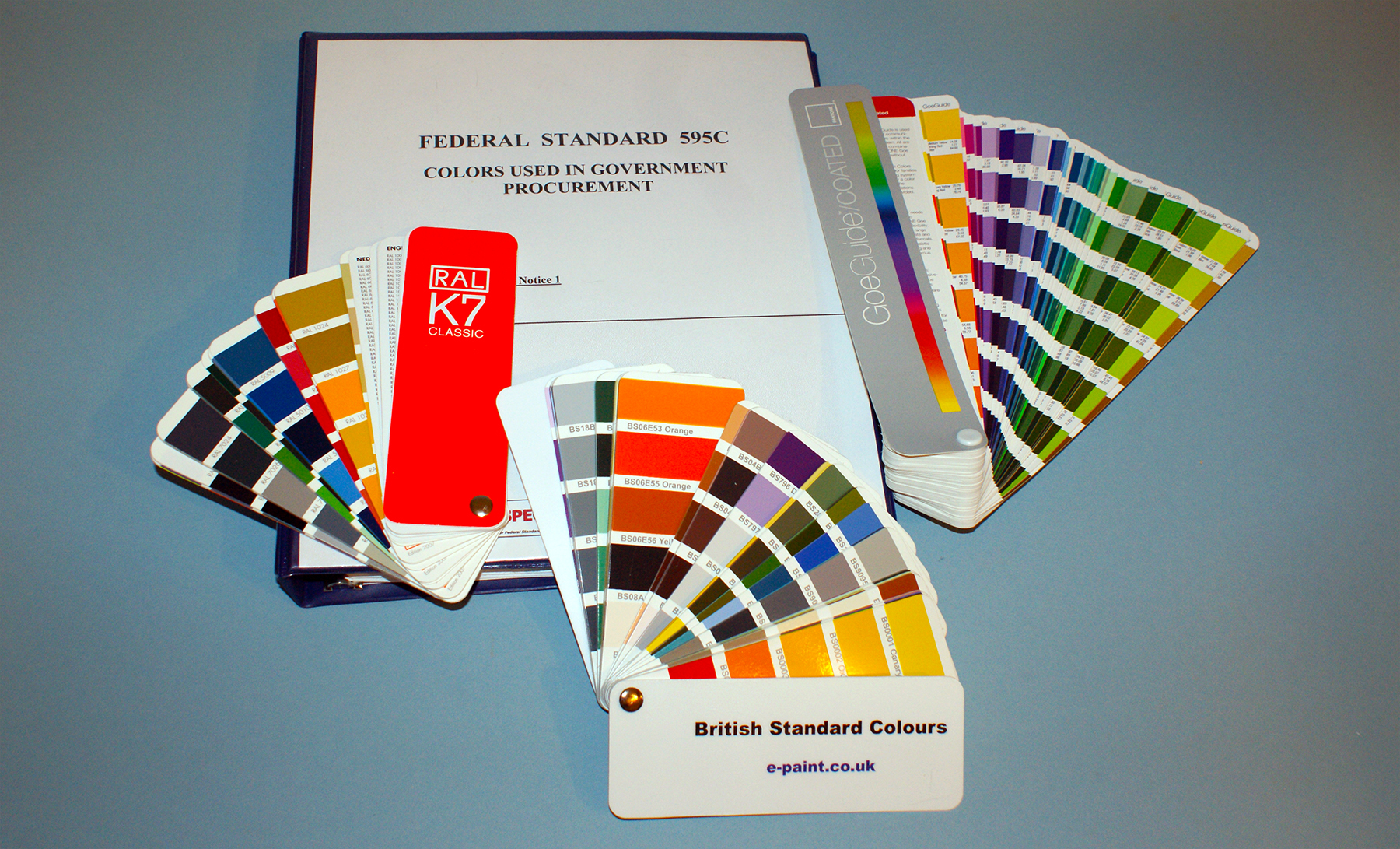
- I’ve had Federal Standard 595b online for some time now, and this was updated to the recent FS595c. For this project, I acquired the British Standards Colors (BSC), the German RAL standards, and the Pantone color sets.
- Forensic Color Standards:
- Finding original color standards for historical eras past can be really difficult, and if you are so lucky, republishing them with the original paint chips is next to impossible.
- RLM (WW2 Luftwaffe colors), there are a number of forensic recreations of the RLM standards available and you can read more about that here.
- QM 3-1 (US pre-WW2 colors), 'The Official Monogram US Army Air Service & Air Corps Aircraft Color Guide Vol 1 provides a wealth of information as well as replicated paint chips.
- ANA (US pre-WW2 and WW2 colors), 'The Official Monogram US Army Air Service & Air Corps Aircraft Color Guide Vol 1' as well as all four volumes of 'The Official Monogram US Navy & Marine Corps Aircraft Color Gude' provide a wealth of information as well as replicated paint chips.
- Regia Aeronautica, there were two references published in Italy some time ago and provided on loan for this effort - 'Colori Ufficialmente Impiegati Dall'aviazione Italiana 1916 - 1943' and 'Campionario Colori della R.A. 1935 - 1943' which provide an excellent resource for taking some of the guesswork out of Regia Aeronautica camouflage colors and their applications.
- Naval Ship Color Standards, Snyder and Short have produced THE reference set of colors replicated out of the archives for a variety of nations' ship colors before and during World War 2. John Snyder (the Snyder in 'Snyder and Short) has since produced the White Ensign Models Colourcoats from these same paint chips as well as other colors.
Note: If you're at all interested in paint colors and how they are used, I'd recommend finding copies of the relevant publications that we listed in the bibliography below. These have been essential references for the Cybermodeler Online lab for many years now and while we're taking the guesswork out of matching historical colors to available hobby paints.
All of these paint chips were digitally measured for RGB values and added to the databases. As more information comes along, these data are also added to the databases and correlated with the information on-hand. No historical information is used nor needed from any of these sources other than the identification of each historical color.
Next, a new set of tools was needed to compare the colors and cross-reference them between each of the standards/sources. This was needed to take out the human analytical aspect of color correlation as it is far too easy to try to apply one's own knowledge of these historical colors in the processing of the data. The object of this exercise was to simply compare colors to see which ones matched or came within a very small statistical percentage of the original color value. As far as I know, this is the first time that FS595c colors were cross-matched to RLM, BSC, RAL, etc., color standards.
One goal of this exercise was to identify colors such as FS 36118 (Gunship Gray) to see what other color from other standards might use the same paint such as ANA 603 (Sea Gray), BSC 632 (Dark Admiralty Gray), RAL 7030, USN #11 (Outside Grey), etc., all which are within 97% percent of the original color. While some are closer matches than others, you'd be hard pressed to see the differences between these colors when painted on similar aircraft or vehicles out in the sunlight. This means that my bottle of Gunship Gray can be used in other applications without having to purchase those specialty colors.
While all of this conversion of data into information is fine (for an academic perhaps), it doesn't do any of us any good unless we can find available hobby paints to match these color applications. Remember that the primary objective of this exercise is simply to find available pre-mixed paints to do a given project. So what is different about this resource? First, I've taken the historical analysis out of the process and treated these colors strictly as data. When colors are correlated as data values, what turned up are some colors that were designed for generic use or for other hobby domains that also fill in some gaps in color coverage. For example, there are Floquil and Pollyscale railroad colors that very closely match the RLM and Regia Aeronautica standards that may be more available at your local hobby shop.
What this has also done for my own sanity is filled in another information gap - Humbrol. Like Testors, Humbrol paint has been around for decades and while they've produced a more limited range of colors, those colors do have multiple applications. The trouble for me was finding a reliable resource for matching Humbrol paints to different standards and applications. That problem is now not only solved, but we now have more applications for Humbrol paints than most other available published resources.
Scale Effect
As our color reference system progresses, we have uncovered a few interesting nuggets that some modelers know about, but the vast majority of modelers many not know. Some hobby paint companies will state or imply that a given paint ‘matches’ a specified color (like FS 36118) but what they don’t mention is whether that paint is directly matched to the standard or has had some degree of ‘scale effect’ applied to it. Aeromaster was one of the paint brands that pioneered the production of scale effect colors and a few other companies followed suit. The problem we have today is knowing which of these colors are direct matches and which have had scale effect applied. That’s where our system will come in handy. For more about scale effect, look here.
Conclusion
Don't be surprised to see this article grow and morph as more information and experience grows out of this color process. In the meantime, I hope you'll find these new resources useful. I'll be keeping the older versions of the color standards online until the new ones are ready to replace them. Enjoy!
Bibliography
- Federal Standard 595a, Washington DC: General Services Administration, 1984
- Federal Standard 595b, Washington DC: General Services Administration, 1989
- Federal Standard 595c, Anaheim: FED-SPECS, 2008
- Archer, Robert D., The Official Monogram US Army Air Service & Air Corps Aircraft Color Guide Vol 1 1908-1941, Sturbridge: Monogram Aviation Publications, 1995
- Elliott, John M., The Official Monogram US Navy & Marine Corps Aircraft Colour Guide Vol 1, Sturbridge: Monogram Aviation Publications, 1987
- Elliott, John M., The Official Monogram US Navy & Marine Corps Aircraft Colour Guide Vol 2, Sturbridge: Monogram Aviation Publications, 1989
- Elliott, John M., The Official Monogram US Navy & Marine Corps Aircraft Colour Guide Vol 3, Sturbridge: Monogram Aviation Publications, 1989
- Elliott, John M., The Official Monogram US Navy & Marine Corps Aircraft Colour Guide Vol 4, Sturbridge: Monogram Aviation Publications, 1989
- Official United States Aircraft Colors 1908-1993, Sturbridge: Monogram Aviation Publications, 2006
- Merrick, K.A., and Kiroff, Jürgen, Luftwaffe Camouflage and Markings 1933-1945 Volume One, Hersham: Classic Publications, 2004
- Merrick, K.A., and Kiroff, Jürgen, Luftwaffe Camouflage and Markings 1933-1945 Volume Two, Hersham: Classic Publications, 2005
- Merrick, K.A., and Hitchcock, Thomas H. The Official Monogram Painting Guide to German Aircraft 1935-1945, Boylston: Monogram Aviation Publications, 1980
- Ullmann, Michael, Luftwaffe Colours 1935-1945, Manchester: Hikoki Publications, 2008
- Luftwaffe Color Chart. Eagle Editions Ltd. 1998
- Colori e Schemi Mimetici Della Regia Aeronautica 1935-1943, Ediz. CMPR, 1977
- Colori Ufficialmente Impiegati Dall'aviazione Italiana 1916-1943, unknown
- RAL K7 Classic, Sankt Augustin: RAL GmbH, 2007
- British Standard Colours, e-paint.co.uk
- US Navy World War II Ship Colors Set 1, Sacramento: Snyder and Short Enterprises, 1998
- US Navy World War II Ship Colors Set 2, Sacramento: Snyder and Short Enterprises, 1999
- Kriegsmarine World War II Ship Colors Set 1, Sacramento: Snyder and Short Enterprises, 2000
- Kriegsmarine World War II Ship Colors Set 2, Sacramento: Snyder and Short Enterprises, 2001
- Imperial Japanese Navy World War II Ship Colors, Sacramento: Snyder and Short Enterprises, 1999
- Royal Navy World War II Ship Colors Set 1, Sacramento: Snyder and Short Enterprises, 1999
- Royal Navy World War II Ship Colors Set 2, Sacramento: Snyder and Short Enterprises, 2000
- Italian Navy World War II Ship Colors, Sacramento: Snyder and Short Enterprises, 2000